
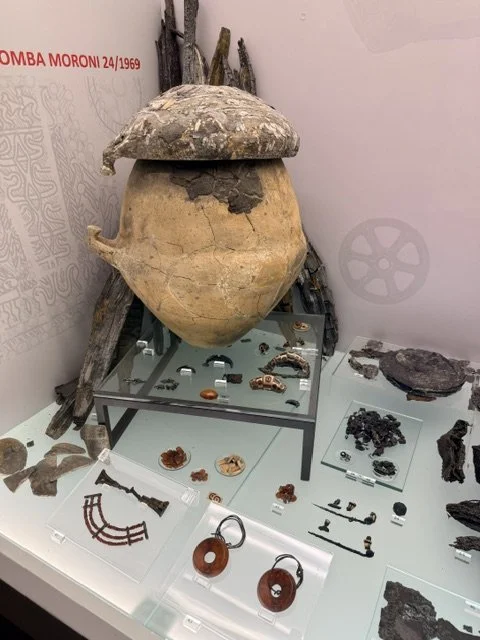
Amber artifacts on display at the Museo Civico Archeologico di Verucchio
Supply Chain Mavens’ Maryanne Ross recently visited the Museo Civico Archeologico di Verucchio in Italy, and the visit gave us a great supply chain story to share.
The museum sits in a 13th-century monastery in the hill town of Verucchio, near Rimini. It holds one of Italy’s most important collections from the Villanovan civilization (9th to 7th century BC), the culture that came before the Etruscans.
The most striking pieces are made of amber. Researchers trace much of it to the Baltic Sea, which means it traveled roughly a thousand miles overland and by river and sea to reach the Adriatic coast. Verucchio sat on the Marecchia valley route, which linked the Adriatic to the Tyrrhenian Sea, so it was well placed to receive amber and pass it along.
How amber reached the rest of Europe
Verucchio was one stop on a much larger network. Amber was gathered along the Baltic and North Sea coasts and moved outward along several corridors:
📍 North to south through Central Europe and the eastern Alps, down to the Adriatic
📍 Along the Atlantic, following the same paths as the tin trade
📍 Toward the east, from the Baltic to the Black Sea
Amber most likely passed hand to hand between communities, with each group trading it onward. Local centers like Verucchio added value by crafting raw amber into finished beads and brooches before it moved again. Baltic amber had reached the central Mediterranean by about 1600 BC, and by about 1000 BC it had gradually replaced Sicilian amber in Iberia.
Then the network shifted
Around 650 BC, Verucchio’s power and trade network went into decline. Researchers point to several factors, including internal power struggles and a reshaping of Adriatic trade as new seaports emerged. Amber did not stop flowing. The southern region of Picenum took over as the main amber-working center on the Adriatic coast.
By the late 6th century BC, trade had moved again. The port of Spina, at the mouth of the Po River, became a main entry point for goods headed to Felsina, today’s Bologna. Amber reached that market through the Veneti, who traded to the north.
What it means for supply chain professionals
Look at what it took to make this work:
📍 Sourcing in one region and demand in another
🛤️ Multiple routes, handoffs, and trading partners
🏘️ A location chosen for its access to the network
💎 Raw material turned into finished goods at the destination
It was a multi-tier network with many handoffs and no single owner of the whole chain. A strong hub depends on the conditions around it. When ports, partners, and routes change, the network reorganizes around the new options.
Sourcing, logistics, network design, and value-added processing are the same concepts our CPIM students study today.
Thank you, Maryanne, for bringing a little ancient supply chain history home with you.
Preparing for your CPIM exam? Explore our courses at Supply Chain Mavens.