

57 Miles, Zero Imported Materials
What Acadia's Carriage Roads Can Teach Us About Sourcing
Most sourcing case studies come from modern supply chains. This one comes from a horse-and-carriage road network built between 1913 and 1940 — and it's a surprisingly clean example of a strategy procurement teams still chase today: sourcing everything within arm's reach of the build site, and controlling quality by controlling the whole process yourself rather than managing it through intermediaries.
The Sourcing Strategy: Don't Ship It In, Quarry It Locally
When John D. Rockefeller Jr. set out to build 57 miles of carriage roads across Mount Desert Island, he faced a sourcing decision that would define the entire project: import stone from established suppliers on the mainland, or source it from the island itself. He chose the island. Road crews quarried granite directly from Mount Desert Island for both road base material and the facing on the network's sixteen stone bridges, drawing on roughly sixty small local quarries scattered across the construction corridor rather than a handful of large contracted suppliers.
That's a meaningfully different model than how the island's granite industry normally worked. Mount Desert Island granite was, at the time, a genuine export commodity — quarried and shipped to build cities up and down the East Coast. Rockefeller's project ran in the opposite direction: instead of feeding stone into a long-distance supply chain, it kept the entire material flow local, cutting transport distance to nearly zero and insulating the build from the shipping delays and cost swings that came with moving heavy stone by rail or barge.
Vertical Integration as Quality Control
Sourcing locally solved the transport problem, but it also solved a quality problem. Rockefeller didn't outsource oversight to contractors and check in periodically — he was reportedly on-site daily when he was on the island, and he kept track of his workforce by name rather than by headcount. At peak construction, the project employed around 250 men, all working under a single owner who was, functionally, also the project's quality inspector.
That kind of vertical integration — controlling sourcing, construction, and inspection under one line of accountability — is exactly what modern sourcing teams try to approximate with supplier audits, on-site quality checks, and reduced layers between buyer and producer. Rockefeller didn't need a supplier scorecard because he was the buyer, the site manager, and the final inspector all at once.
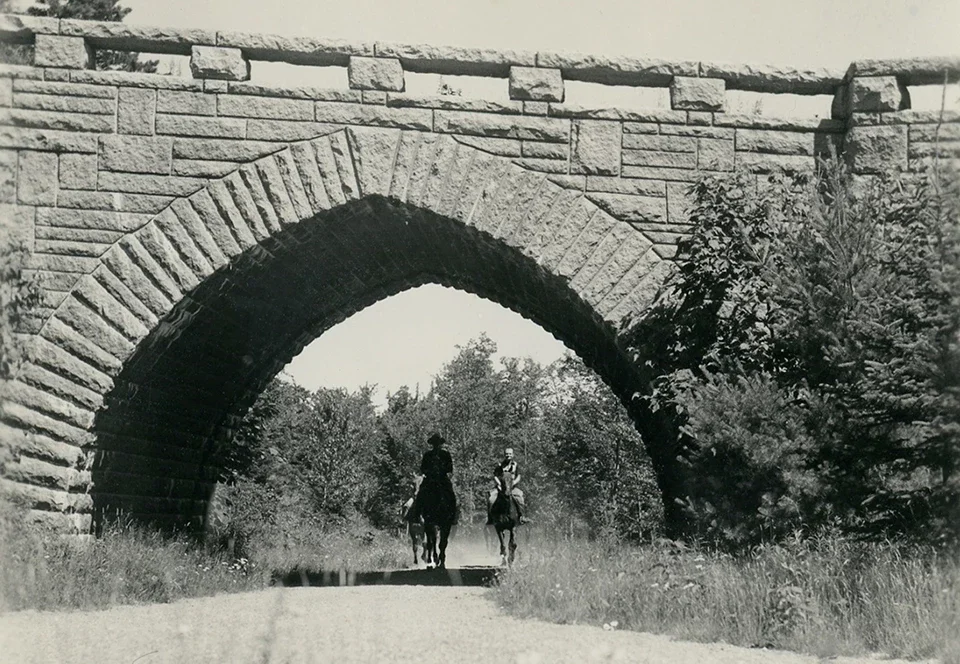
Eagle Lake Carriage Road in 1939. Photo: National Park Service, Acadia National Park
Engineering Spec Driven by Durability, Not Cost
The material specification itself was built for longevity in a harsh coastal environment, not for minimum viable cost. Each road used a three-layer broken-stone construction: a six-to-eight-inch base of larger stones, a middle layer of progressively smaller stone, and a finished surface of gravel bound with clay, plus wide ditches and stone culverts engineered to handle Maine's wet, freeze-thaw climate. That spec is a big part of why roughly 44 of the original 57 miles are still in active use more than a century later — a durability outcome that's hard to separate from the sourcing decision that preceded it. Locally quarried granite, inspected and placed under the direct eye of the person paying for it, produced infrastructure that outlasted the century it was built in.
The Takeaway
Strip away the horses and the Gilded Age setting, and the carriage roads are a case study any sourcing team would recognize: reduce transport risk by sourcing close to the point of use, tighten quality by shortening the distance between buyer and builder, and spec for durability when the cost of failure is measured in decades rather than quarters. Rockefeller didn't have that language for it. He just wanted roads that would still be there when his grandchildren rode them — and sourced accordingly.
Sources: